
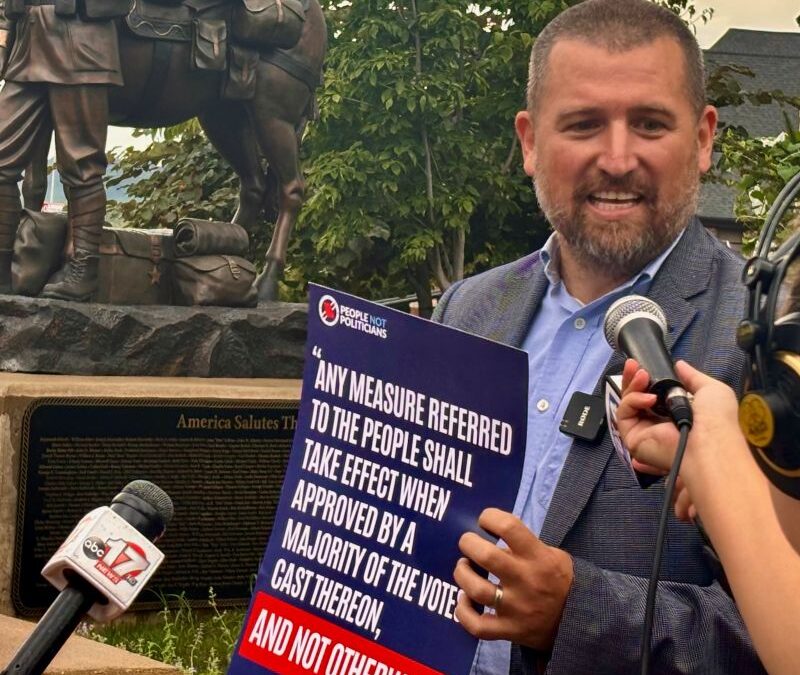
* Three consequential cases are headed to the State Supreme Court that test the rights of voters against the responsibilities of the elected. The lawsuit heard Aug. 19 in Cole County Circuit Court raises questions that both sides called “unprecendented.” Veteran state government reporter Rudi Keller takes a deeper look.
by Rudi Keller, Missouri Independent
Whether Missourians vote in a referendum on congressional redistricting could turn on the question of what happens to the Aug. 4 primary results, arguments Wednesday in a Cole County courtroom showed.
Candidates were nominated in Missouri’s eight districts but six of those districts were redrawn as part of the gerrymandered map passed in 2025 to give Republicans an edge in the 5th District.
The People Not Politicians referendum, if allowed, would disenfranchise the voters who participated in those primaries, attorney John Gore, representing three national Republican committees, told Cole County Circuit Judge Daniel Green.
“It’s difficult to imagine any kind of judicial order that would cause more widespread voter confusion or erosion in confidence in the integrity of this state’s elections than the relief plaintiff seeks,” Gore said.
The consequences of a decision that upholds the law are not a legally sufficient reason to deny a vote, said attorney Chuck Hatfield, representing People Not Politicians, the political action committee that sued Secretary of State Denny Hoskins after he denied the referendum a spot on the ballot despite it having enough signatures to qualify.
The proposal was insufficient, Hoskins argued, because it is not a legal exercise of the referendum power.
“The secretary kind of reasons backwards and says, ‘well, judge, if you find that this measure is sufficient, that’s going to wreak havoc.’ And that doesn’t matter,” Hatfield said. “The question is, what is the law?”
Green promised to deliver his answer “quickly” when the trial adjourned after 90 minutes. Whatever decision he makes is certain to be appealed and the deadline for courts to add items to the ballot is Sept. 8.
The Missouri Supreme Court, which sent Green a letter last week asking for swift action, showed its interest in everything involving the referendum when it acted Tuesday to take over hearing an appeal in a case over how many signatures should be checked on a referendum petition.
On Monday, Cole County Circuit Judge Christopher Limbaugh ruled that almost 103,000 signatures, gathered before the petition form was approved Oct. 14, were invalid. An appeal was filed with the Western District Court of Appeals but the Missouri Supreme Court took it “as the case involves a question of general interest or importance.”
The Supreme Court set arguments on the signature case for Sept. 2.
For People Not Politicians, the case heard Wednesday is over the meaning of the word “any” in the Missouri Constitution’s referendum section. It says that “any act” of the General Assembly is subject to a referendum, with exceptions for bills addressing emergency needs and appropriations for the operation of state agencies, institutions and education programs.
“When the language of the constitution is clear and unambiguous, the court has no duty but to apply the language that is written, and when the language is clear, the court may not resort to canons of construction to arrive at a different result,” Hatfield said.
In 1962, when the Missouri Supreme Court upheld a congressional redistricting plan, Hatfield said, it said a valid plan is subject to a referendum.
“Judge, to me that’s the end of it,” Hatfield said.
Lou Capozzi of the attorney general’s office, representing Hoskins, said Hatfield’s was wrong and “his legal theories are frankly absurd.”
The U.S. Constitution vests sole authority for designing congressional district maps with legislatures and does not contemplate state votes. States can make a specific delegation of that authority to another body, such as the independent commissions used in some states, he said.
The deadline for deciding if a referendum petition on a redistricting plan has sufficient signatures for the ballot is the same day as the primary, Capozzi said.
If Missouri allowed a referendum on redistricting, he said, the deadlines would give time to change the districts before a vote.
“If Missouri had made that choice, (lawmakers) would have set up a sensible, logical system,” Capozzi said.
Hatfield, in response, said Capozzi is stretching his argument too far.
“To assume that our legislature would make a logical choice is a major fallacy,” Hatfield said.
Gore represents the Republican National Committee, the Republican Congressional Campaign Committee and the Missouri Republican State Committee.
So far, Put Missouri First, the committee opposed to the referendum, has raised $3 million from national GOP PACs. People Not Politicians has raised $7.2 million.
An election campaign over the referendum is likely to cost many multiples of those amounts.
Richard von Glahn, executive director of People Not Politicians, said he is expecting an expensive campaign but that voters will make the right choice.
“I understand that there will probably be a large spend,” von Glahn said, “but Missourians know a clunker when they see it.”
Missouri Independent is part of States Newsroom, a nonprofit news network supported by grants and a coalition of donors as a 501c(3) public charity. Missouri Independent maintains editorial independence. Contact Editor Jason Hancock for questions: [email protected].